

Recently, I surveyed men’s ministry leaders from around the state to ask what issues they were facing in reaching and discipling men. The number one issue mentioned was reaching younger men, which can seem daunting, but I have some news you may find interesting. (Men’s ministry leaders also asked for more information about reaching unchurched men and discipleship strategies. Stay tuned. More information is coming on these topics.)
While Gen Z is turning to chatbots more and more, you may be surprised who else they’re turning to for life-shaping advice. Given the current trends among Gen Z (born 1997-2012), reaching young men in their teens and 20s should be seen as a golden opportunity!
Intergenerational Faith and Emerging Adults
Young men are in a liminal stage of life, moving from adolescence into adulthood while making difficult decisions about identity, vocation, relationships and where to live. This season is best navigated not in isolation but with the guidance of older generations who can offer wisdom, stability and lived experience.
The church is one of the last truly intergenerational spaces and, therefore, one of the most important settings for spiritual and emotional growth. Despite being dubbed “digital natives,” Gen Z craves in-person connection and is open to mentorship. Couple that with the fact that Gen Z is not resistant to older adults and you have a great opportunity in the church.
Most of us over 45 didn’t want to hang out with “old folks” when we were younger, but Gen Z isn’t like that. They are deeply receptive to them. Many young adults are losing confidence in major institutions such as Hollywood, the media and government, yet they trust older generations more than other social institutions.
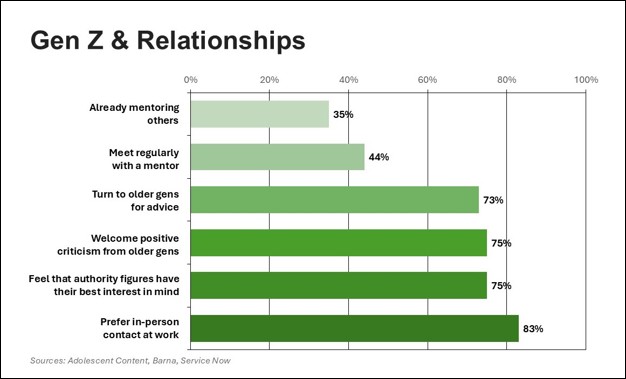
Both the secular workplace and the church reveal that Gen Z wants personal contact. Eighty-three percent of Gen Z prefers in-person interactions with supervisors, 75% welcome positive criticism from older generations and 73% turn to older adults for advice when making difficult decisions. In other words, the desire for mentorship is already present; the church simply needs to recognize and cultivate it.
As I shared this information with one group of pastors in northeast Alabama, I could tell by the looks on their faces that they found it hard to believe. Then a student pastor raised his hand and commented, “This is true. I recently surveyed our students to find out how we could improve our student ministry. The number one answer was, ‘Have more older people involved!'”
This generation is different. They are open to having older people around, which sounds more like a family than generational silos. Church, let’s recognize the opportunity before us.
The Church as a Family
The church should function like a family rather than a segmented institution. Community in the church includes the whole age spectrum, reinforcing the idea that congregational life naturally brings generations together. That kind of setting gives younger believers access to people who are further along in faith, marriage, work and parenting.
It also creates room for older adults to pass on wisdom in ordinary, relational ways instead of only through formal teaching roles.
This intergenerational environment is not a bonus feature of church life but a necessity. Research shows that intergenerational relationships are among the strongest factors in the development of mature faith among emerging adults. When older believers intentionally befriend, train and walk alongside younger adults, the church becomes healthier and more faithful to its mission to make disciples, which is our biblical mandate (Deut. 6:4-9; Matt. 28:19-20; Titus 2; 1 Peter 5:5-9).
Mentoring Matters
Biblical mentoring is one of the clearest ways to support young men. Mentoring is a lived expression of Christian discipleship, modeled by Jesus Himself, who personally shaped the lives of His followers. A spiritual mentor gives a younger believer not only information but perspective, encouragement and accountability.
The mentor’s role is especially valuable because it can feel more objective and less emotionally tangled than advice from parents or peers. In his research, David Kinnaman of the Barna Group concluded that spiritual mentoring is one of the strongest predictors of resilient faith.
Among Christians ages 18 to 29 who persisted in life-changing faith, a large share reported having older adult friends in the church. The relationship itself, not just the advice or curriculum, is the key ingredient that makes mentoring effective. A mentoring relationship demonstrates that the young person matters and belongs in your church.
Belonging and Well-Being
Young adults need more than guidance; they need a sense of belonging. One of the greatest challenges young adults face in the church is feeling known, valued and included. Intergenerational relationships create that sense of belonging by showing younger people that they are part of a larger spiritual family, which is not only spiritually important but also emotionally significant.
Many young people who leave the church cite a lack of belonging as a primary reason for disengagement. By contrast, resilient disciples tend to report feeling connected to other Christians, loved in church and connected to older people. In this sense, belonging is not a side issue; it is central to both spiritual health and member retention.
A Better Way Forward
Men, your ministry should intentionally build intergenerational discipleship into its culture. That can happen through mentoring relationships, shared worship, teaching opportunities, mission trips and ordinary friendships across age groups.
It also requires older adults to see themselves as active participants in the spiritual development of younger believers. When churches create spaces for vulnerability, conversation and mutual trust, they help younger men feel understood rather than isolated.
If you’re keeping score, here’s what we have: a spiritually open generation looking for mentorship and turning to older generations. Put that together with churches that are primarily made up of people whom Gen Z would consider “older” (Millennials, welcome to the club). We have a golden opportunity for discipleship right now.
Church should be more than a place where young men attend services. It should be a community where they are known, guided, challenged and loved by people of every generation. That kind of church does not simply retain young adults; it helps them become resilient disciples, emotionally healthy adults and people of lasting faith.
Let’s not allow AI to raise the next generation. Be the one a young man turns to for practical spiritual guidance. Chances are, there’s already someone nearby watching you. It’s time to take him to lunch.
SOURCES:
- Why Gen Z Isn’t Interested in Your Statements, Promises and Commitments–Yet,” Morning Consult Pro. June 2020.
- Barna Group, The Open Generation: United States Country Report: How U.S. Teens and Young Adults Relate to Jesus, View the Bible and Make an Impact, Ventura, CA: Barna Group, 2022. 39.
- David Kinnaman, Mark Matlock and Aly Hawkins, Faith for Exiles (Grand Rapids, MI: Baker Books, 2019), 131.
- Jim Davis, The Great Dechurching: Who’s Leaving, Why Are They Going, and What Will It Take to Bring Them Back? (Grand Rapids, MI: Zondervan, 2023), 123–24.